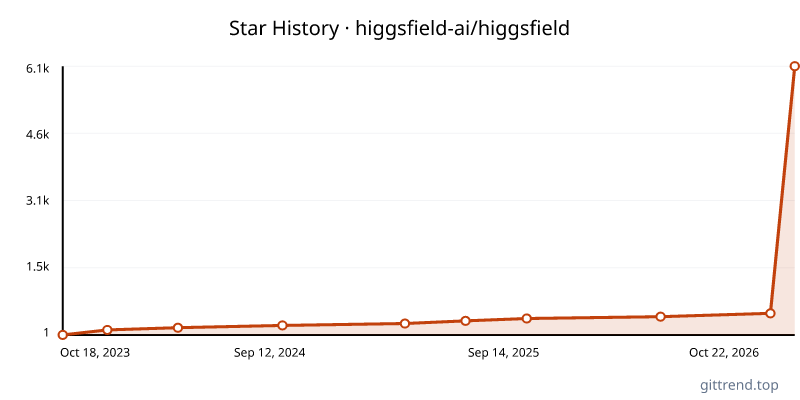
Overview
Higgsfield is a groundbreaking open-source framework designed to tackle the immense challenges of training colossal machine learning models, such as Large Language Models (LLMs) with billions to trillions of parameters. It combines fault-tolerant, highly scalable GPU orchestration with a streamlined machine learning framework, empowering researchers and developers to train the next generation of AI models without the usual complexities and frustrations.
Key Features
- Massive Model Training: Specifically architected for models with billions to trillions of parameters, enabling the training of state-of-the-art LLMs.
- Advanced GPU Orchestration: Manages GPU compute resources, providing exclusive and non-exclusive access to users for their training tasks, ensuring efficient utilization.
- DeepSpeed ZeRO-3 & PyTorch Sharding: Seamlessly integrates with DeepSpeed's ZeRO-3 API and PyTorch's fully sharded data parallel API for highly efficient model and data sharding.
- End-to-End Experiment Management: Facilitates the initiation, execution, and comprehensive monitoring of large neural network training across allocated nodes.
- Resource Contention Management: Features a robust queueing system to manage running experiments and handle resource contention gracefully.
- CI/CD for ML: Integrates directly with GitHub and GitHub Actions, enabling continuous integration for machine learning development and effortless deployment.
- Environment & Configuration Simplification: Eliminates "environment hell" and "config hell" by simplifying dependency management and experiment argument definitions, ensuring reproducibility.
- Broad Cloud Compatibility: Tested and supported on major cloud providers including Azure, LambdaLabs, and FluidStack, with flexibility for others.
Typical Use Cases
- Large Language Model (LLM) Development: Training and fine-tuning LLMs with unprecedented scale, pushing the boundaries of natural language understanding and generation.
- Distributed Deep Learning: Conducting large-scale distributed training for various deep learning architectures that demand significant computational resources.
- Reproducible ML Research: Ensuring that complex experiments can be easily replicated by simplifying environment and configuration management.
- MLOps Integration: Building robust CI/CD pipelines for machine learning workflows, automating the deployment and execution of training jobs.