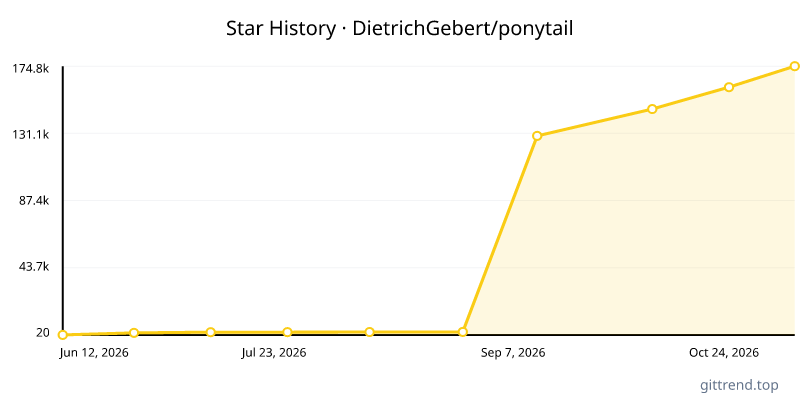
Overview
Ponytail is a revolutionary AI agent skill designed to instill the wisdom of the "laziest senior dev" into your AI coding assistants. It champions the philosophy that the best code is the code you never write, drastically reducing unnecessary complexity and promoting elegant, minimal solutions. Ponytail works by enforcing a strict ladder of code generation principles, ensuring that agents only write what is absolutely necessary, while never compromising on safety, validation, or essential features.
Key Features
- Radical Code Reduction: Achieves significant reductions in Lines of Code (LOC) and token usage (up to 54% less LOC and 22% fewer tokens in benchmarks), leading to faster execution and lower costs.
- Intelligent Code Generation Ladder: Implements a hierarchical decision-making process: checks for necessity (YAGNI), existing codebase reuse, standard library utilization, native platform features, and installed dependencies before resorting to new code.
- Unyielding Safety and Quality: Guarantees 100% safety, including trust-boundary validation, data-loss handling, security, and accessibility, even while minimizing code.
- Seamless Integration: Offers straightforward installation across a wide range of AI coding environments and CLIs, including Claude Code, Codex, GitHub Copilot CLI, Gemini, and more.
- Actionable Commands: Provides powerful commands like
/ponytail-reviewto identify over-engineered code and/ponytail-debtto manage deferred optimizations.
Typical Use Cases
Ponytail is ideal for developers seeking to:
- Accelerate AI-assisted development: Minimize the boilerplate and redundant code generated by AI agents, allowing them to focus on core functionality.
- Optimize AI operational costs: Reduce the number of tokens processed and the computational resources required for AI code generation.
- Enhance code quality and maintainability: Ensure that AI-generated code is lean, efficient, and adheres to best practices by default.
- Refactor existing AI agent behavior: Apply the "lazy senior dev" principles to existing AI workflows to prune unnecessary complexity.
- Educate AI agents on efficient coding: Train AI models to prioritize minimal, effective solutions over verbose or premature implementations.