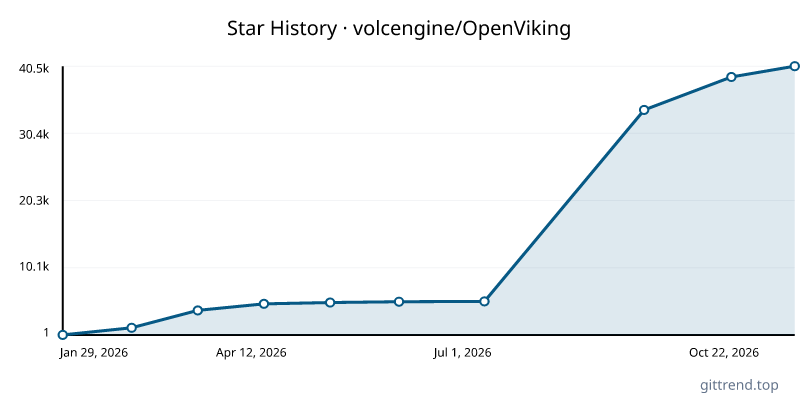
Overview
OpenViking is a revolutionary, self-evolving context database designed to empower AI agents. It seamlessly unifies agent memory, knowledge retrieval augmented generation (RAG), and skills into a single, virtual filesystem accessible via the viking:// protocol. Instead of opaque vector stores, agents navigate their context with familiar file system commands, enhancing transparency and control.
Key Features
- Unified Context Filesystem: Manages memories, resources, and skills under a single
viking://URI, allowing agents to interact with context like files. - Tiered Context Loading: Processes data into three tiers (abstract, overview, details) for efficient on-demand loading, significantly reducing token consumption.
- Directory Recursive Retrieval: Intelligent retrieval prioritizes higher-level directories before drilling down, ensuring results are delivered with their surrounding context intact.
- Observable Retrieval & Debugging: Every retrieval action leaves a traceable trajectory, enabling users to understand and debug how context was accessed.
- Session Memory Evolution: Automatically extracts user preferences and agent experiences from sessions into long-term memory for continuous improvement.
- Broad AI Agent Integration: Offers out-of-the-box integrations with popular agents like Claude Code, Codex, Hermes, LangChain, and more.
- Open-Source & Extensible: Fully open-source under AGPLv3, with commercial editions available for managed SaaS and self-hosted enterprise solutions.
Typical Use Cases
- Enhanced AI Agent Recall: Provide agents with persistent, structured memory for long-term conversational recall and personalized interactions.
- Contextual Knowledge RAG: Integrate external documents, codebases, and web data as a knowledge base for AI agents, enabling precise and context-aware information retrieval.
- Skill Management for Agents: Organize and deploy reusable skills and tools that agents can discover and leverage, akin to a developer's toolkit.
- Debugging and Observability: Understand exactly how an AI agent accesses and utilizes its knowledge and memory during complex tasks.
- Building Stateful AI Applications: Develop sophisticated AI applications that require robust, evolving context management for complex workflows.